


Stringed Instrument Maintenance: What should you do, and what should you take to a luthier?
Updated: Feb 10
As I started my violin shop, I had all types of repair requests coming in. Some were quite complex, like resetting a neck that had come unglued, while others were simply fixing a collapsed bridge. I love helping people make their instrument sing again, but some people are intimidated by what they might think of as a costly repair, when the reality is they could probably fix it on their own. Just like car maintenance, some people prefer to trust their investment to the experts, and that's perfectly acceptable too! I wanted to write this, though, for the type of people who like to do their own oil changes. In an oil change, it's important that you use the right oil for the car and do the correct procedures, since doing something the wrong way will lead to costly fixes down the road. It's the same with violin maintenance--a repair done incorrectly or with the wrong material will lead to issues later on. As a general rule of thumb, someone with good mechanical sense and proper equipment should only touch parts that are not glued to the violin. If you ruin a bridge or tailpiece or soundpost or strings, it's a simple matter to replace it, but if you ruin part of the violin, it's either a whole new violin or expensive repair. Of course, there can be unintended consequences of poor repairs to the more external parts of a violin, such as poorly fitting a soundpost that destroys the inside of a violin and will lead to a soundpost patch, one of the most technically demanding repairs. In any case, I wrote this for students, teachers, and those curious about how to best care for their instrument; my purpose is to enable and encourage those curious about introductory luthiery, not to scare away with dire warnings of how everything can and will go wrong unless you take your precious instrument to a luthier! I hope that these guidelines will help you on your musical journey.
Maintenance that every student should do
To help you succeed in mastering the art of playing the violin, let's start by embracing a few essential maintenance practices. Your teacher will guide you through these in your very first lesson, setting you up for success from the start! The common theme for this level of maintenance is that it's something you should do every time you practice. Relying on someone else to do this would prohibit practicing!
Tighten and Loosen Bow
Tightening the bow gives it just the right amount of tension to pull a lovely sound from the violin or perform a lively spiccato. When you pull your bow out of the case, tighten the screw on the end of the bow until the gap between the stick and hair is about the same width as the stick at the closest point. Before putting your bow back, make sure you loosen the screw again. This is important so the bow doesn't loose the precise curve (called the camber) that makes it work so well. The camber was put in the bow by simply heating and bending the stick. So what will happen if you have the bow under tension in a hot case? Sure enough, the same recipe that gave it the curvature in the first place will take it right out, and your bow will not work as well. That's why it's important to loosen and tighten the bow every time you play.

Rosin Bow
Rosin is an essential part of making your instrument work! Without it, the horsehair in your bow doesn't have enough friction to grab the string and make it vibrate. If your violin sounds thin and raspy, like it's whispering, that most likely means you don't have enough rosin on your bow. A cake of rosin will last you for years. To apply, simply move the tightened bow across the rosin cake a few times before each practice session. There is such a thing as adding too much, and you can see that when there is visible rosin dust coming off! You will also notice a harsh sound coming from your instrument. That's when you want to be extra careful to Wipe Off Rosin.
Tune Strings
Modern strings are made of a combination of synthetic or steel cores and metal windings. As the temperature or the amount of moisture from your hand or in the air changes, the strings will slacken or tighten, which changes the pitch. Tuning is simply tightening or loosening the strings, and the tuners are held by friction, so the violin can also get bumped and get knocked out of tune. All of these make it so that your violin will likely need to be tuned each time you play. If your violin is out of tune, it won't "sing" as much, since the sympathetic vibrations from open strings won't resonate with each other. Here is one of my favorite tutorials on how to tune a violin. Beginners should have fine tuners on all strings; intermediate players should consider only having a tuner on the E string; advanced players traditionally only ever have an E string fine tuner.
Check Bridge Alignment
This may not be something that you have to do every time you play, but you should check your bridge alignment about weekly. As you tune your strings up and down, the force can tilt the bridge towards the fingerboard (you can mitigate this by Lubricating String Grooves in the Bridge and Nut). If you give it enough time, you might be in the middle of a practice session, then hear a loud *SNAP!* as the bridge collapses forward under the tension of the strings. Not to worry, it's an easy fix, but it can be a shock the first time it happens. The correct bridge position is a 90° angle between the tailpiece side of the bridge and the belly (top) of the violin. You can easily grab a business card to check this angle. If you notice it's off, it's best to loosen the strings. If you feel comfortable moving the bridge, you can see how to properly align it in Straighten the Bridge; otherwise, bring it to your teacher and they will help you!

Wipe Off Rosin
As you play your violin, you may notice a white powder starting to accumulate on it right under the strings by the bridge. This is perfectly normal (in moderation), it's just excess rosin that didn't stick to the hair of your bow. If you leave it on, it will start to look ugly and dirty, and can also degrade the varnish of the violin (the varnish gives the violin its lovely color and also protects the wood underneath). Simply wipe it off after each time you play using a lint-free microfiber cloth (you don't want the cloth to scratch the varnish). While you're at it, wipe off the rosin on the bow stick, for the same reasons.
There are also important things to avoid to care for your violin. You should never leave it in extreme temperatures or in a car. The wood and joints will swell and move, and cracks will open in the seams, and you'll have to take it to someone to properly repair it. You should also avoid touching the hair of the bow. The oils in your hands will cause the rosin to not stick to the hair, and you'll get that whispery sound again.
There we go--not so bad! It may seem like a lot to keep track of at first, maybe like your first time getting on a bike to attempt to ride it. But just like all the motions of riding a bike, these will all quickly become second nature. Don't worry if it seems like it takes all your practice time to just go through this checklist at first; soon enough, you'll be able to do it all within a minute or two!
Maintenance that teachers and advanced students should do
These tasks require a certain level of mechanical aptitude, but no specialized tools. They don't come up frequently, but when they do, having some know-how in this area can be quite beneficial. They address common problems that might be overwhelming for students but are easily solved.
Install Strings
The most common reason a violinist will change strings is if they break or start to unravel. However, they likely need to be changed long before that time (if they are breaking frequently in the same spot, have a luthier check for sharp edges on the bridge or nut). You can tell it's time for new strings because they'll go "false". Play or pluck an open string, let it ring, and listen for a slight change in pitch. If you hear it change, it means it's time for new strings! I've found the tidiest way to change strings is to unwind all of them at once rather than trying to change them one-by-one and weaving them into a tightly packed pegbox. However, doing so will displace the bridge, so if you're uncomfortable with the section Straighten the Bridge, then only unwind one string at a time and replace it. The soundpost, which is only held in by friction, may also collapse, so check out the section on Reset/Adjust Soundpost. This is also a good time to Apply Peg Compound and Lubricate Strings Grooves in the Bridge and Nut.
If you have removed all of the strings, then start putting the new ones starting with the string that goes to the lowest peg (nearest the fingerboard) and working your way up. On a violin, this means G, E, D, then A. This leaves plenty of room in the pegbox for each string since the strings on higher pegs won't be in the way. A nicely wound string isn't necessary, but it looks nice and appears professional. I usually do the following while holding the violin facing me with the C bouts between my legs. First put the ball end of the string into the appropriate slot on the tailpiece or fine tuner. Then stick the end of the string into the peg hole so that it goes all the way through, and start twisting the peg. Wind it 2-3 turns away from the pegbox wall, then cross the string over itself and do the rest of the windings towards the pegbox wall. Holding the string under slight tension with your free hand will help you to have nice wraps. As the tension tightens, make sure the string falls into the correct groove on the bridge and nut. If the E string doesn't have anything on the bridge to protect it from the string, make sure the plastic sleeve that comes with the string goes over the bridge so that it doesn't cut into the bridge. Tune it up gradually rather than one string at a time so you keep relatively even tension.
Straighten the Bridge
As discussed in the section Check Bridge Alignment, the bridge will naturally get displaced over time with use. You will also need to do this each time you Install Strings. If the bridge is not warped and still in good condition, you can do a simple adjustment without doing much work. Loosen the strings slightly so they still hold the bridge in place, but loose enough that you can move it freely. First, move the feet to the correct spot. On a correctly made violin, this will be in line with the inner nicks of the sound holes, and centered between the sound holes. It's important to get this part in the correct place, since a correctly cut bridge will have feet that fit the exact curvature of the violin in this spot, and moving a few mm away will result in a different sound from your violin. Once this position is set, tilt the bridge so that the tailpiece side forms a 90° angle to the belly (top) of the violin. Then tighten up the strings slightly, make a few more adjustments, then bring it up to tuning!
I find it helpful to conduct all of these fine movements by supporting my hands on the C-bouts and grabbing the bridge from either side.

Apply Peg Compound
Your tuning pegs are held entirely by friction. Too much friction means that they're hard to turn and therefore hard to tune (do your pegs click as you twist the peg?). Too little friction means that they won't hold the tension of the string and won't hold a tuning. When you turn your pegs, you should be able to do so smoothly with no clicks or jumping, but also easily enough to do so with just one hand (you need the other hand to bow!). Here's where peg compound comes in. Simply pull the peg out and apply a little bit around where it comes in contact with the wall of the pegbox (the wood will look a little extra shiny there). Then reinsert the peg, give it a few twists, and enjoy the newfound ease of tuning!

Lubricate String Grooves in the Bridge and Nut
As you tighten and loosen strings during tuning, the friction on the bridge and nut of the violin can wear on the strings, leading to early breaking, a leaning bridge, or simply difficulty tuning. This is a pretty simple fix, and something you can easily do each time you change your strings. With the string out of the groove, take a pencil and scribble a few marks inside the groove. This will deposit some pencil graphite, which is the perfect thing to keep those points of friction lubricated.
Install New Fine Tuners, Chin Rest, and Tailpiece
All of these are accessories on a violin that are easily changed with a few screwing motions. There are many varieties of each of these, so I'll only talk about the common ones.
A chinrest is the easiest and probably the most important to change. Violins will come with a generic chin rest, but we all have different jaw lines, and if you're using the wrong chin rest, you likely will have extra tension as you hold the violin. Your teacher may have many different styles to try out, or your local luthier or music supply shop can help you out. Try some out with your shoulder rest and see what's the most comfortable. To remove a chinrest, grab a paper clip and unwind it, and use it to unscrew the clips holding the chin rest. No need to unscrew them all the way, just enough to pull the chinrest off the violin! To install a new chinrest, place it in the approximate location where it will go on the violin, use the paper clip to grab the holes, and screw the threads together. Be careful that the paper clip doesn't poke all the way through and scratch the varnish. If you're unsure about what style of chinrest to use, a center-clamping chin rest is usually preferable, since there's a solid block that it clamps onto instead of the more delicate ribs.

To install a fine tuner, you need to first remove the string from the tailpiece. The fine tuner has two parts that will unscrew. The first part is the tuner knob that you turn to raise and lower the pitch of the string (go ahead and twist that around a few times and see if you can work out how it does this!). This has to come all the way off, so that the other bolt-type part can unscrew all the way off as well. Then feed the threaded post of the fine tuner up through the appropriate hole in the tailpiece, screw in the bolt-type part nice and snug, and then screw in the fine tuner knob. I prefer to keep this pretty loose initially, since most of the time we tune we end up increasing the tension to bring the pitch up, which means more often you'll be screwing the fine tuner in rather than out.

A new tailpiece will involve Installing Strings, so make sure you're comfortable with that. First, remove all the strings. The tailpiece is held on by looping a piece of nylon around the endpin. If your new tailpiece already has the nylon gut installed, you're in luck. If not, get a piece of nylon tailgut from your luthier or music store. You'll see little brass threads on the end; unscrew these all the way off, then feed them into the narrow end of the tailpiece, where you'll see two little holes. Once both ends are fed through, thread the brass screws back on. The length of the tailgut is actually an important consideration in this process. While the part of the string that you bow and finger is fixed based on the distance between the nut and bridge, the length of the string behind the bridge (called the afterlength) can affect the resonance of your instrument, because that short string length can also produce overtones. Most luthiers will make the ratio of 1:6 afterlength:playing length. A way to check this is if you pluck the open D string and afterlength of the G string, you'll get a D sounded a few octaves apart. So if the afterlength sounds a little sharp, that means you want to flatten the afterlength pitch. Do this by increasing the afterlength (just like taking off a finger makes the string length longer and the pitch lower), which you do by shortening the tailgut (screwing in the brass threads a little bit more). As a side note, this afterlength pitch is the reason I prefer to use Hill-style fine tuners on the E string when I put in new fine tuners.

Maintenance that requires specialized tools, for beginning luthiers
This final section isn't a detailed how-to for these more advanced repairs; rather, it's an introduction and invitation to learn more. I'll cover the specialized tools and some reasons you'd want to conduct the repairs/adjustments. Those interested are always welcome to arrange some time in the workshop with me to observe, and I'll leave enough instructions that will trigger a memory once you've had some practice. I do want to caution everyone on these, though; if not done properly, they can cause serious damage that will be much harder to fix!
Glue Open Seams
The most important part of this is to use the correct type of glue: hide glue! An open seam is part of the life of a violin, and is the sign that everything is relatively healthy. It is far better for a joint to fail at the glue seam than in the wood, because that makes it an easy repair. If you use a really strong glue like wood glue or epoxy, you'll get cracks in the plate because that's the easiest avenue to relieve stress that is introduced to wood from fluctuating temperature and moisture. Hide glue is also meant to be reversible, so if you do need to conduct a repair that involves taking the top off to access part of the violin, an experienced luthier can do so safely without damaging the violin. To glue an open seam, you'll need a thin putty knife, some rib clamps, and some thin hide glue (it should run off your brush almost in a stream, rather than individual droplets; if there are droplets, add water, and if the stream is too thin, add more glue granules). Work out any dirt or debris from the open seam with the putty knife while the glue heats up. Then use the putty knife to work in the glue, clamp the ribs together, and brush off excess glue that squeezes out.
Reset/Adjust Soundpost
The soundpost is the small rod the spans the top and back plates of the violin just under the treble side (right side when looking at the violin) of the bridge foot. It serves important acoustical functions, and moving it slightly can drastically change the sound of the violin. That's why it's often called the "soul" of the violin when translated from other languages. If you're unsatisfied with the tone of your violin, adjusting the soundpost is the cheapest way to see if you can fix it (also try new strings, a new bridge, and in really nuanced cases a new tailpiece/shoulder rest/chin rest). It is only held in by friction, so sometimes when you're Installing Strings it may fall out and you'll hear a rattling inside of the violin. You'll need a round piece of spruce with tight grain, a knife or chisel to fit the soundpost to the angles of the top and back, and a soundpost setter to maneuver it inside the violin through the sound hole. There are also lots of optional aids to help you set or retrieve the soundpost, including other various holders, retrieval tongs, an inspection mirror, and a marking gauge.

If you're installing a new soundpost, first cut the soundpost to the approximate length. Then you'll take several cuts and gradually fit it to the exact angle and distance between the plates. Ensure that the grain is oriented perpendicular to the grain of the top. Once it is fit to the violin, you'll do the same procedure you will also follow to reset a fallen soundpost or adjust. That is, place it in the approximate position, and look through the sound holes and endpin holes to check that it is square (use the blocks as a reference). A good initial placement is just inside the bridge on the treble side and towards the tailpiece about 3mm from the edge of the foot of the bridge. The fit should not be super tight, but firm--a squeeze of the ribs should be enough to displace it. Once the violin is strung up, you can play it and adjust the position slightly to get different sounds out of the violin. I recommend making only occasional adjustments, since the violin needs a bit of time to settle into its new norm. As a general rule of thumb, the east/west movement is set by the length of the post, and you'll be able to hear if it's too tight or too loose by the violin sounding constrained or hollow. If the sound is shrill, nudge it backwards/south, and if it's dull move the soundpost towards the bridge/north.
Fit a Bridge
After adjusting the soundpost and trying new strings, the bridge is perhaps the best way to adjust the tone of your violin without breaking the bank. You may also simply need a new bridge if your current one has warped or wasn't cut right. You can do everything to fit a bridge with a belt sander, a knife, a mousetail file, and a template. For a more finessed professional-quality bridge, I suggest using planes and files instead of the sander. It not only leaves a crisper, more professional look, but also gives better control of the final outcome for a precise fit. A bridge jack is extremely useful but not necessary. Finally, a piece of parchment to protect the E string slot is usually added to prevent the thin metal string from cutting into the bridge.
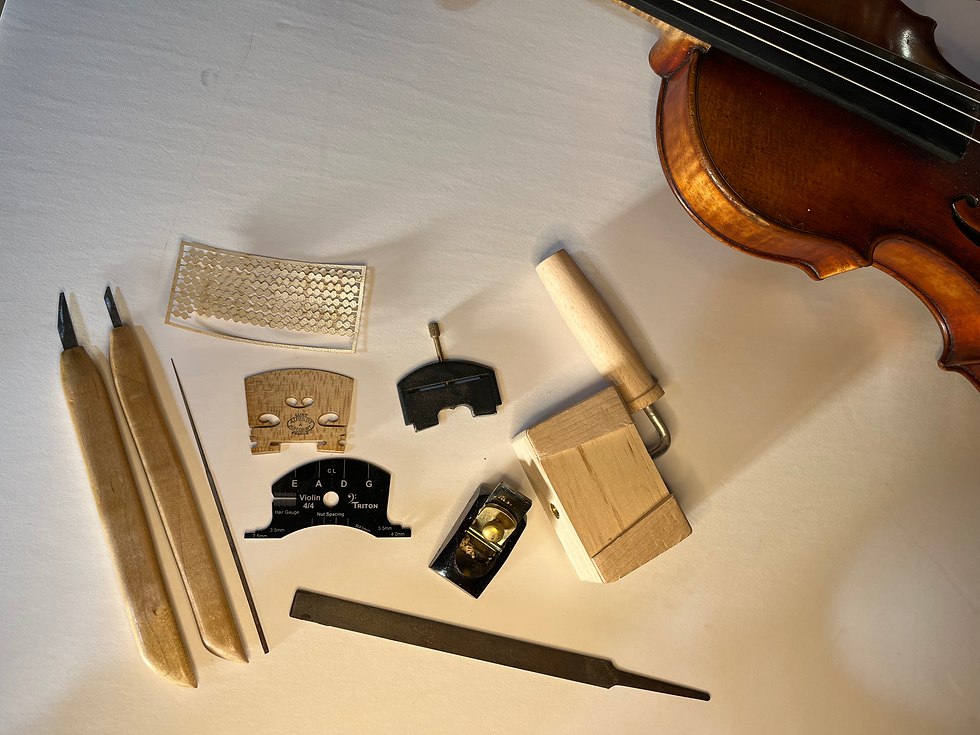
You'll want to first make sure the soundpost is placed in its approximate position (see Reset/Adjust Soundpost). The soundpost introduces a slight flex and can change the curvature, so this allows you to get an exact fit of the feet to the bridge. Some people have varying and equally valid opinions about whether the long rays or shorter spots should be the flat side should face the player; the best advice that I've heard regarding this from Michael Darnton is to choose an approach, rationalize it sufficiently to yourself, and go with it. I personally keep the brand stamp side (longer rays) flat and facing the player. Fit the bridge feet exactly to the curvature of the correct placement (see Straighten the Bridge). You can either do this with a piece of sandpaper placed on the belly for a good fit or carbon paper and a knife for an exact fit. Thickness the bridge to the appropriate level based on your template, adding all of the curvature to the fingerboard side of the bridge. The next part is a little trick I learned to avoid constantly pulling the bridge in and out to get the right height. String up the violin but use the bridge jack instead of the bridge. This lets you adjust the height to the exact action you want (action is the term used to describe the height of the strings above the fingerboard). A typical amount is 3.5 mm above the fingerboard on the E side and 5.5 mm on the G side, but individual preference can change that slightly. Once you have the height, take the bridge jack out mark the height on your bridge. Use the bridge template to mark the curvature and cut it out. Check the string action one more time and make any refinements to the height and thicknesses. Carve out the kidneys and heart (I recommend being conservative) and any other decorative flourishes you desire, mark the string grooves and file them out, and glue a piece of parchment over the E string slot. If you want to darken the bridge, fume it with ammonia or apply a thin layer of shellac.
Install New Pegs
The main reason to change pegs is aesthetic—to give your violin a new look. You’ll likely change the tailpiece and chin rest to match. Or perhaps you want to install geared pegs to make tuning easier (especially on a cello or Hardanger fiddle). Or, over time, as you tighten and push the pegs in, they will make a bigger and bigger peg hole. At some point, old violins need to have the peg hole made smaller; this requires adding bushings, and is an advanced repair that you should take to your luthier. The tools that you need for new pegs are a peg reamer and peg shaver with 1:30 taper. This matching taper is important, as pegs are held in purely by friction. You’ll also want a small drill bit and mousetail file for the string holes, some calipers, a saw, and a file.

Start with reaming the hole, and make this as small as possible (thus giving longer life to the pegbox before it requires bushings). Then slowly shave off the pegs until they fit exactly in the holes (about 12 mm between the ring and the outside of the pegbox). Be really careful about chipping off the ring. At 1:30 taper, a small little shaving off of the peg or peg hole can cause a significant change, so be careful as you get close to the final fit. Clean up the shavings around the ring with a file. There will be a part of the peg sticking through the end of the pegbox; grab a pencil or scribing knife, hold it against the edge of the pegbox as you twist the peg; this marks exactly where you want to cut off the peg (a sign of a professionally fit peg is that it ends flush with the pegbox). After cutting to length, file the end to a slight round and sand it with fine sandpaper. I usually give the end of the peg a little prick with the awl—4 pricks for G, 3 for D, 2 for A, and 1 for E—to keep them straight. Put the peg back in, mark a spot approximately 2/3 the width of the pegbox with the shorter end on the side of the peg, and drill a hole through this (a #56 bit is about right). Use the mousetail file to ease the entrance into the hole. Apply Peg Compound and you’re set to Install Strings!
Note: fitting new pegs is basically the same process as fitting a new endpin on a violin! Simply use the same reamer and shaver.
Rehair a Bow
This is the most involved yet most common of these types of repairs. With that comes an extra warning about causing more damage to the bow. If you put too much hair in you can cause cracks, if you use glue in the wrong places it can become a nightmare the next time you rehair, and there are lots of little pieces that you can easily lose. I won’t provide a summary of the steps here, but rather give a simple overview of why you would want to rehair your bow and the tools you will need. For a step-by-step guide, I recommend Harry Wake’s Violin Bow Rehair and Repair book or Henry Strobel’s Violin Maker’s Notebook.
There are several main reasons you’d want to change your bow hair. Usually when a bow is brought to me, it’s already visibly lost a good portion of its hair—that’s usually far too long between rehairings! The first reason may be with seasonal changes. If you have a big swing in temperature and humidity in your area, the hair will grow and shrink with the changes. The mortise that your frog can move along as you Tighten and Loosen the Bow is only a limited length of the bow, so if the hair shrinks or expands more than that, you’ll need a rehair simply to get the bow to relax or tighten properly. On a longer time scale, the hair will stretch as you hold it under tension and play, so it will someday be too stretched out to properly tighten, and you’ll need a bow rehair. The other reason you’d need a bow rehair is if the oils and grime of regular use accumulate on the bow hair. This means that the rosin won’t stick to the hair and you’ll start seeing the same issues as with an unrosined bow. You may be able to get more use out of it by cleaning the hair all the way off with soap and water. In the end, though, the maker cannot tell you how often to rehair a bow, only the player can. If it is working for you, there is no need to rehair. If it's been a few years, it's worth getting a bow rehair, though, and seeing if it makes a difference--just like using a razor daily, you may not notice as it gets steadily duller until you pull out a new blade and realize how sharp a new one is!

Most people use a customized bow rehair jig that they make based on their method of rehairing. You’ll need high quality horse hair (if the bow is only worth low quality hair, it’s probably cheaper to get a new bow than to have it rehaired). The other tools needed are some wood scraps for new plugs, a chisel, some string to tie knots, and various other optional but useful tools to hold, prod, and manipulate the many parts that you’ll deal with. It’s always nice to leave all of the metal parts with a nice polish as well. Here you can see my whole toolbox of tools and parts just for bow rehairs.

Conclusion
The maintenance items discussed only scratch the surface of violin repairs. Other repairs you should bring to your luthier. If you have a desire to learn some of these common repairs, first practice on student instruments. Know your limits! I hope this enables you and gives you confidence in how to care better for your own instrument.
